
What if our competitors understand our markets better than we do?
Research is to see what everybody else has seen, and to think what nobody else has thought.
Albert Szent-Gyorgyi
Ten years ago, a Chinese national was convicted of stealing sensitive data from Lockheed Martin—data that contributed to the development of the Chengdu J-20 stealth fighter.
Today, reports suggest China is aggressively acquiring U.S. AI capabilities.
This pattern isn’t random.
Nations don’t steal everything.
They steal what they believe will matter.
Beginning years ago and continuing to this day, I have received multiple, highly similar outreach requests from Chinese academics—fully funded by their government—seeking access to my research.
I declined—every time.
But looking back, what stood out wasn’t the request.
It was the pattern.
These weren’t casual inquiries.
They were focused on financial systems, resource allocation, and optimal market boundaries—the exact areas where competitive advantage is determined.
That raises an uncomfortable question:
What if our competitors are investing more effort into understanding how markets actually work… than we are?
Because most Western analysis still treats markets as equilibrium systems.
But markets don’t behave that way.
They have limits.
They have boundaries.
And companies fail when they exceed them.
These boundaries are called Demand Frontiers.
Ignore these limits, and you get the next Airbus A380. In 2000, after watching Boeing sell 822 747s over the previous 20 years, Airbus decided to launch the A380, roughly 50% larger than the 747, which sold for a similar premium. Airbus predicted it would sell 1,250 aircraft over the project’s production run. They sold 251 and, in the process, lost 25 billion Euros. A detailed analysis of the Upper Demand Frontier of that market in 2000 indicated that their chances of reaching their target were well below 1 in 1,000.
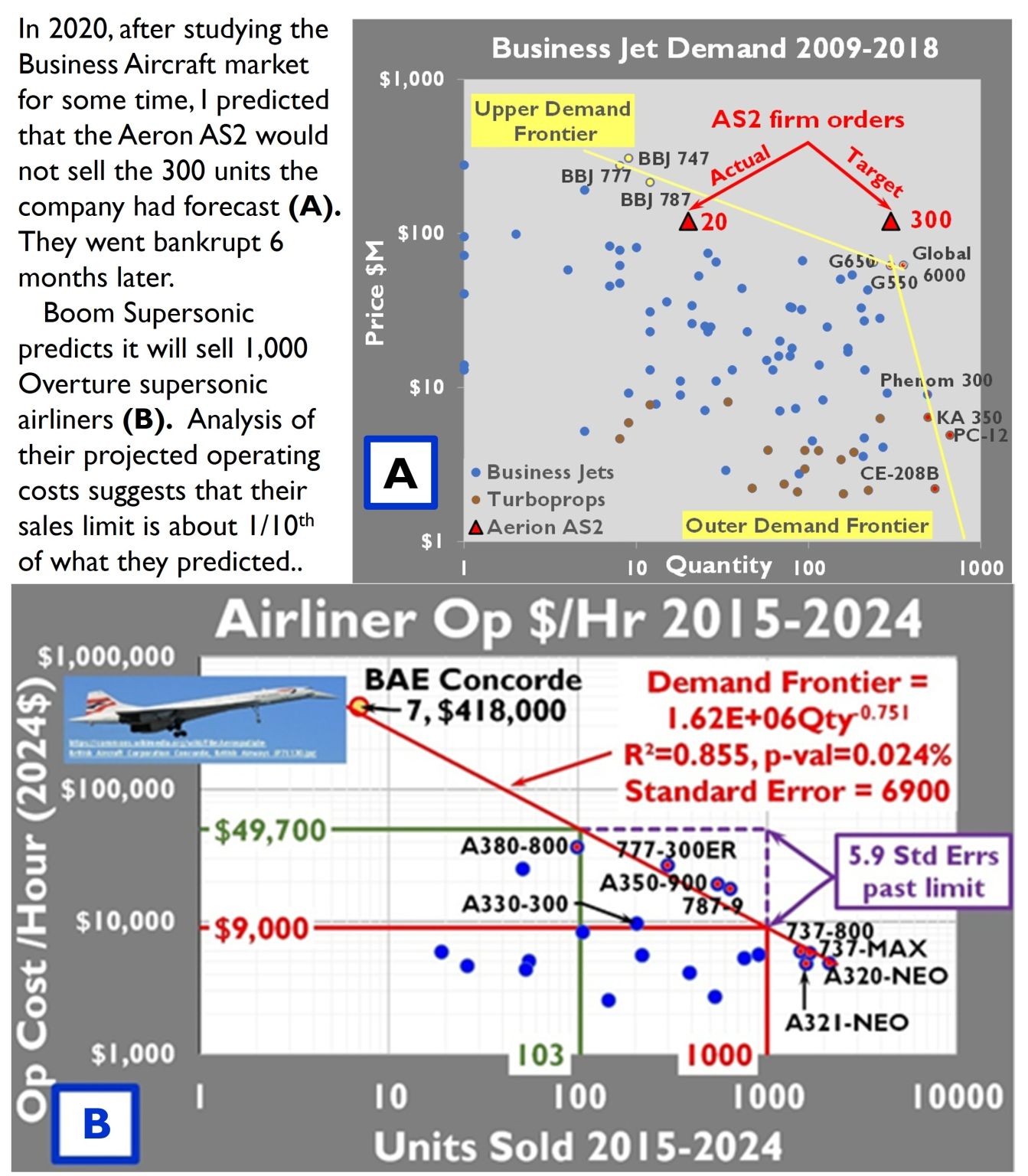
In (A) below, Aerion tried to exceed what the business aircraft market would have allowed in terms of sales. They, too, ran afoul of the Demand Frontier. Their losses were roughly $1B to $2B.
Boom Supersonic, with its proposed Overture airliner (B), will face the same limit, crushing its bottom line. They’d like to sell 1000 of these supersonic aircraft. Having not studied the market limits, they are destined to sell a fraction of their goal.
If, instead of ignoring Demand Frontiers, firms actively analyzed and plotted them, they would find where the market actually supports success.
Say what you will about China, when it comes to civil aviation, they’ve not made the mistake of trying to outpace a market that clearly signals its limits.
So here’s the real issue:
If others are actively studying how to identify and exploit these limits…What happens to those who aren’t?
#iptheft #ip #hypernomics #newidea