Different Forms, Same Function, But Abiding By Identical Limits

The Dude abides.
The Dude, from The Big Lebowski

We’ve seen it over and over again.

A new product is entering the market, and everyone who helped bring it to life believes it will revolutionize the industry. And, with respect to its Value (i.e., its sustainable price based on its features), they often do.

The supersonic Concorde sold for $46M (in 1977), compared to the subsonic McDonnell Douglas DC-9 ($7.6M in 1977), which carried the same number of passengers.

The hypersonic AGM-183A missile, at $42M (2016$), costs more than the high subsonic AGM-158-1 JASSM-ER, at $1.9M (2016$).

The Concorde was projected to sell 350 units. They sold 14. Meanwhile, the DC-9 sold 976 units.

The Congressional Budget Office saw a market for 300 AGM-183As. One was sold. The JASSM-ER has sold 3360 units to date.

In both cases, the Demand Curves weren’t broken. They were instead ignored. Had those curves in those timeframes been properly characterized, neither program should have launched.

At the beginning of the modern era of mass-produced electric cars, many saw the market as brand-new.

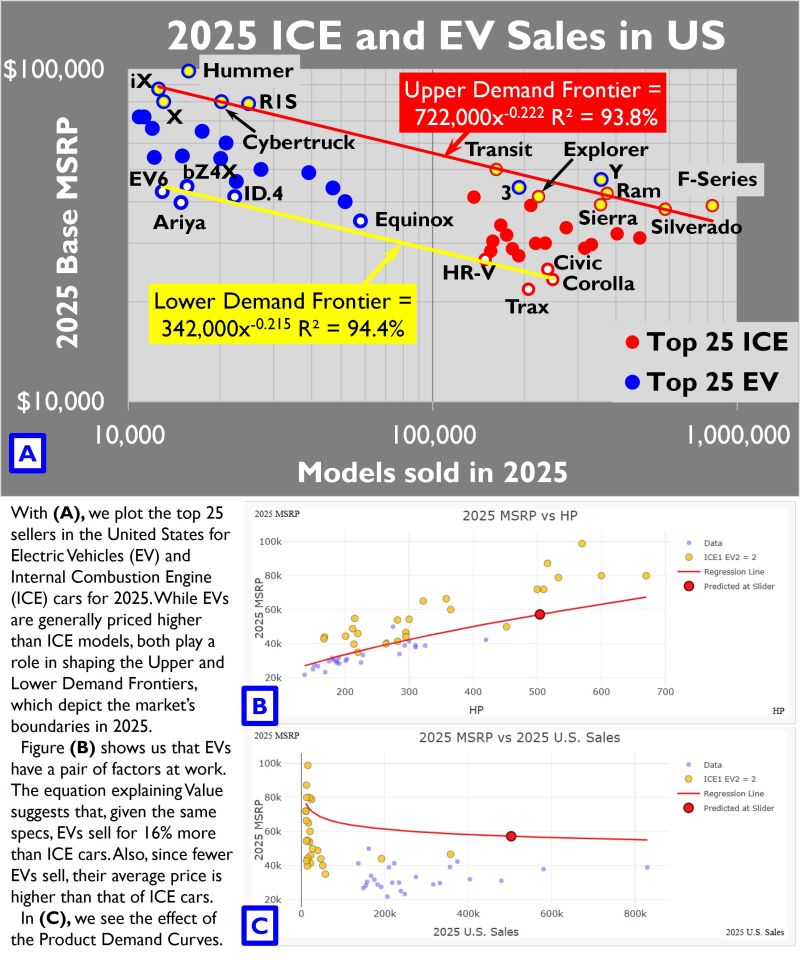
But, as we see in Figure (A) below, while the top 25 sellers of Electric Vehicles (EVs) in the US command higher prices than the top 25 Internal Combustion Engine (ICE) vehicles, both are bound by the same Demand Limits. At the lower end of the market, a group of EVs (EV6, Ariya, Equinox, etc.) joins a similar group of ICE machines (including the Trax, Corolla, and Civic) to form the Lower Demand Frontier. The Upper Demand Frontier is formed by, among others, EVs such as the Tesla X and Hummer at the high end, and the Model 3 and Y at the low end, with familiar ICE market leaders, Ram, Sierra, and the F-Series.

The ability of the Models 3 and Y to sell so many models is both a testament to Tesla’s low costs, along with the market’s overall Value proposition, which, for the 50 models studied, is:

2025 MSRP = 3780*HP^0.574 * ICE1 EV2^0.211 * 2025 U.S. Sales^-0.076

The Sales Term (U.S. Sales-0.076) rounds to the equivalent of a 95% Product Demand Curve. At the same time, the industry typically demonstrates an 85% Learning Curve. Thus, Prices will not fall as fast as costs, meaning that the overall Upper Demand Frontier forms the market limit.

With the Lower and Upper Demand Frontier slopes of -0.22, the market offers far more money at its lower end than at higher prices. Will these slopes continue at the same rate if new, low-cost machines are added to the lower end of the market, or will the market experience steep downward breaks in its Demand Frontiers, as we’ve seen in Business and General Aviation aircraft, revealing that the market has reached saturation?

Designers of the next model entering the automotive market must understand its limits.

The Dude abides.

You should, too.

#evs #ice #hypernomics #demand
Do you presume to criticize the Great Oz? Yeah. Count me in.

Professor Marvel never guesses; he knows!
Professor Marvel (aka The Wizard, from The Wizard of Oz)

Imagine you are a modern-day Dorothy going off to quiz the Wiz. His side gig as a Professor is no secret to you. You’ve been told of the Law of Supply and Demand, maybe second-hand from him. You want to know about it. You want to learn. What can he teach you?

Instead of counting on a tornado to get you and your dog to your destination, perhaps you take a Lyft in an Electric Vehicle (EV) from your house to the airport, fly to where the Wiz is, get off the plane, get in another EV, and stop at the yellow brick road.

As you walk into the Royal Palace, an unseen voice booms over loudspeakers: “I am Oz the great and powerful!”

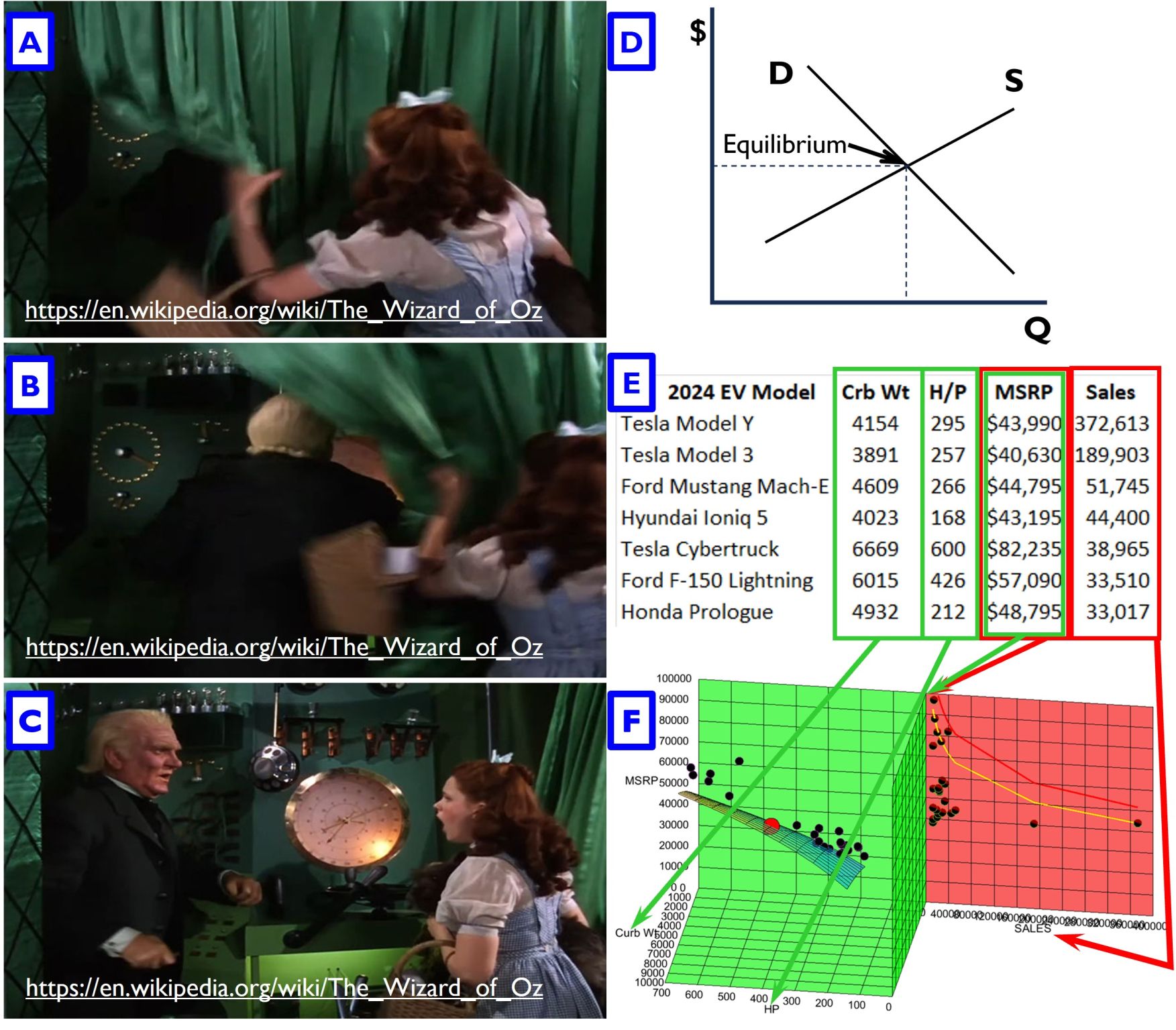
“Yes. Right. Quite,” you say. “I also understand that you are a Professor. What can you tell me about Figure (D)?”

“Ah yes,” the voice bellows, “in all markets there is only one quantity-price point, where supply and demand meet, at equilibrium. It’s the Law of Supply and Demand, the law of the economic land.”

You say, “Let’s think about that. I took 2 different EV models to get here today. That means there wasn’t one equilibrium point in that market. At least two models are in use there, and we know there are many more, as shown in (E).

The room is fogged up, except for a curtained area in a corner (A). Your dog doesn’t like the look of it and pulls back the curtain (B), revealing Oz as nothing more than an ordinary man (C).

You march up and begin a conversation face-to-face.

“Why do you persist in touting a 2D model that can’t describe a market as ubiquitous as that for Electric Vehicles?”

“Well, what other system could there possibly be?” the Professor demanded.

You say, “That’s funny that you should ask. If we plot the last two columns of Figure (E), we get the Red Demand Plane in Figure (F). The first three columns from Figure (E) give us the Green Value Space in Figure (F). When we combine them, we have a market map in multiple dimensions, one that enables us to identify uncontested market spaces. It reveals where models are overpriced, underpriced, or gaps in the market that those not using such a map can’t see.”

The Professor starts to understand. “Why, now that you mention it, I can see no competitors in the price range from roughly $59,000 to $75,000. Is that what you call a ‘Price Gap’?”

“Yes,” you coach him along, “that’s a Price Gap. If you studied it from another angle, you’d find no competitor has a model with more than 426 horsepower but less than 516.”

“A Horsepower Gap?”

“Exactly,” you continue to encourage.

“So if we put up a new model with, say, 471 horsepower that was worth $67,000, the model reveals we have no direct competition?”

“Precisely,” you fire back.

“So, by creating this drawing, we are realizing insights we can’t see without it. Why aren’t we teaching this in school?”

“You tell me, Professor.”

#hypernomics #evs

Why Keep Prices Low

Always deliver more than expected.
Larry Page, Former CEO of Google

Have you ever wondered how Elon Musk managed to become the wealthiest person in the world?

I know I did.

In the space industry, we knew that by selling SpaceX launch platforms for less than their projected Value, Musk drove SpaceX revenue higher. How might that strategy work in the Electric Vehicle (EV) market?

I found the top 25 best sellers in the EV market in 2024. Suppose you were to try to predict the EV Value. If you did, you’d find that it goes up with horsepower (as expected), curb weight (not expected, but since virtually every model had a five-star rating, added mass was a measure of crash survivability), and model sales (the Value for each subsequent delivery falls).

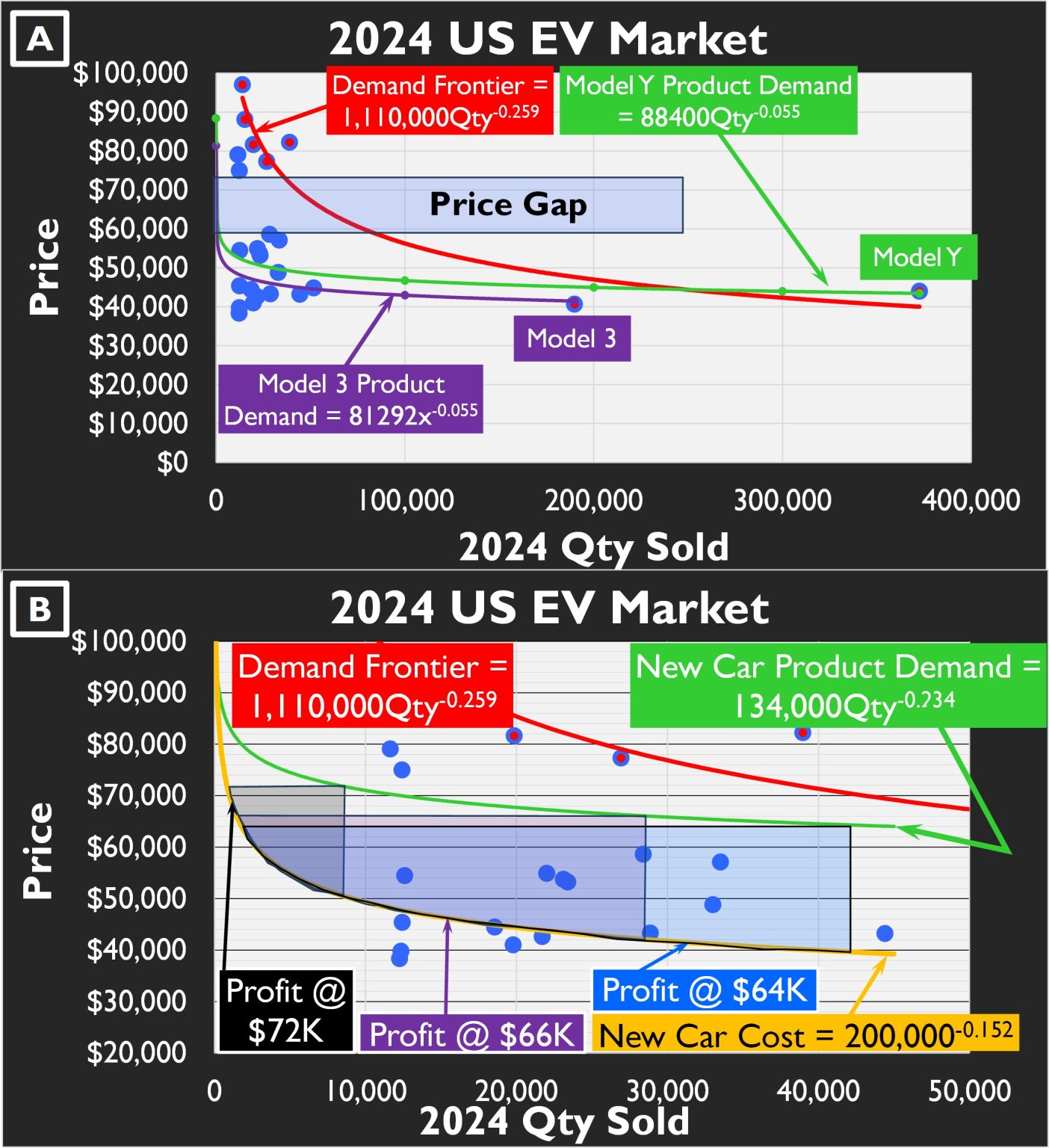
In (A), we observe that this market forms a well-correlated Upper Demand Frontier, with Tesla Model Y and Model 3 commanding the low-priced portion, where most of the market’s revenue lies. Between them, they control over half the revenue that the top 25 models produce. A company can make more money if it can drop a model’s price and cost simultaneously.

Suppose you wanted to enter this market. While curb weights are well distributed across it, there are no vehicles with more horsepower than the Ford F-150 Lightning (Pro SR) at 426 horsepower, or less than the BMW iX (xDrive5) with 516 horsepower. The target for a proposed new model aims to split that difference. At the time of the study, no model was priced between the Cadillac Lyriq (RWD Tech) at $58,590 and the Tesla Model S (Dual Motor) at $74,990. Rather than compete head-on in highly contested market spaces, you could decide to put yourself roughly in the middle of both of the horsepower and price gaps, with a curb weight of 5,000 pounds, 471 horsepower, and projected sales of 28K units in a year, and a target price of $66K for a vehicle, as we do in (B). These specifications form a New Car Product Demand Curve (in Green, which comes from our recurring price term in the regression analysis for Value in these models) and an assumed New Car Cost (Learning) Curve. The difference between the price and the recurring costs is profit.

Our car is nominally worth about $66K. If we sell it for $72K, we get the profits in the black-shaded box in (B), with the earliest possible recurring breakeven point. If we sell it for $66K, as designed, recurring breakeven comes later, but we make more profit, as shown by the purple-shaded area. Paring the price down another $2K to $64K drives a delayed unit breakeven point, but profits (in the blue-shaded area) grow.

While there are additional factors to consider here (movements over time, network effects, feature packages, etc.), it is clear that Hypernomics unlocks previously hidden market patterns, enabling enhanced profits.

And who wouldn’t want that?

#hypernomics #ev #evmarket