
Do you presume to criticize the Great Oz? Yeah. Count me in.
Professor Marvel never guesses; he knows!
Professor Marvel (aka The Wizard, from The Wizard of Oz)
Imagine you are a modern-day Dorothy going off to quiz the Wiz. His side gig as a Professor is no secret to you. You’ve been told of the Law of Supply and Demand, maybe second-hand from him. You want to know about it. You want to learn. What can he teach you?
Instead of counting on a tornado to get you and your dog to your destination, perhaps you take a Lyft in an Electric Vehicle (EV) from your house to the airport, fly to where the Wiz is, get off the plane, get in another EV, and stop at the yellow brick road.
As you walk into the Royal Palace, an unseen voice booms over loudspeakers: “I am Oz the great and powerful!”
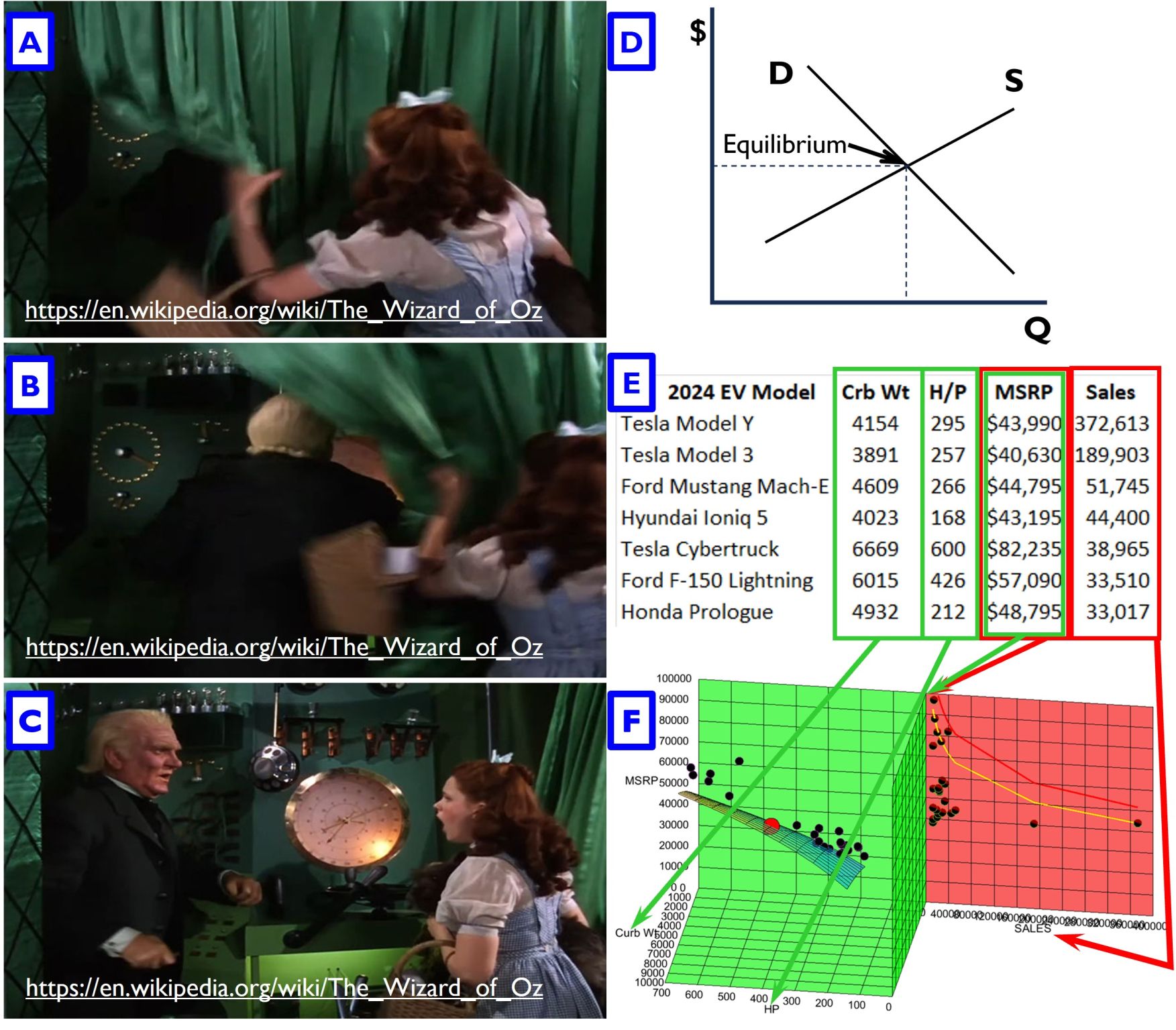
“Yes. Right. Quite,” you say. “I also understand that you are a Professor. What can you tell me about Figure (D)?”
“Ah yes,” the voice bellows, “in all markets there is only one quantity-price point, where supply and demand meet, at equilibrium. It’s the Law of Supply and Demand, the law of the economic land.”
You say, “Let’s think about that. I took 2 different EV models to get here today. That means there wasn’t one equilibrium point in that market. At least two models are in use there, and we know there are many more, as shown in (E).
The room is fogged up, except for a curtained area in a corner (A). Your dog doesn’t like the look of it and pulls back the curtain (B), revealing Oz as nothing more than an ordinary man (C).
You march up and begin a conversation face-to-face.
“Why do you persist in touting a 2D model that can’t describe a market as ubiquitous as that for Electric Vehicles?”
“Well, what other system could there possibly be?” the Professor demanded.
You say, “That’s funny that you should ask. If we plot the last two columns of Figure (E), we get the Red Demand Plane in Figure (F). The first three columns from Figure (E) give us the Green Value Space in Figure (F). When we combine them, we have a market map in multiple dimensions, one that enables us to identify uncontested market spaces. It reveals where models are overpriced, underpriced, or gaps in the market that those not using such a map can’t see.”
The Professor starts to understand. “Why, now that you mention it, I can see no competitors in the price range from roughly $59,000 to $75,000. Is that what you call a ‘Price Gap’?”
“Yes,” you coach him along, “that’s a Price Gap. If you studied it from another angle, you’d find no competitor has a model with more than 426 horsepower but less than 516.”
“A Horsepower Gap?”
“Exactly,” you continue to encourage.
“So if we put up a new model with, say, 471 horsepower that was worth $67,000, the model reveals we have no direct competition?”
“Precisely,” you fire back.
“So, by creating this drawing, we are realizing insights we can’t see without it. Why aren’t we teaching this in school?”
“You tell me, Professor.”
#hypernomics #evs